What destroyed Heidelberg Castle — and why it was never rebuilt
Planning your visit?Guided-tour slots are limited — interiors can only be seen on one — and cancellation is free up to 24 hours before. Reserve today, decide later.
Check availabilityThe residence at its height
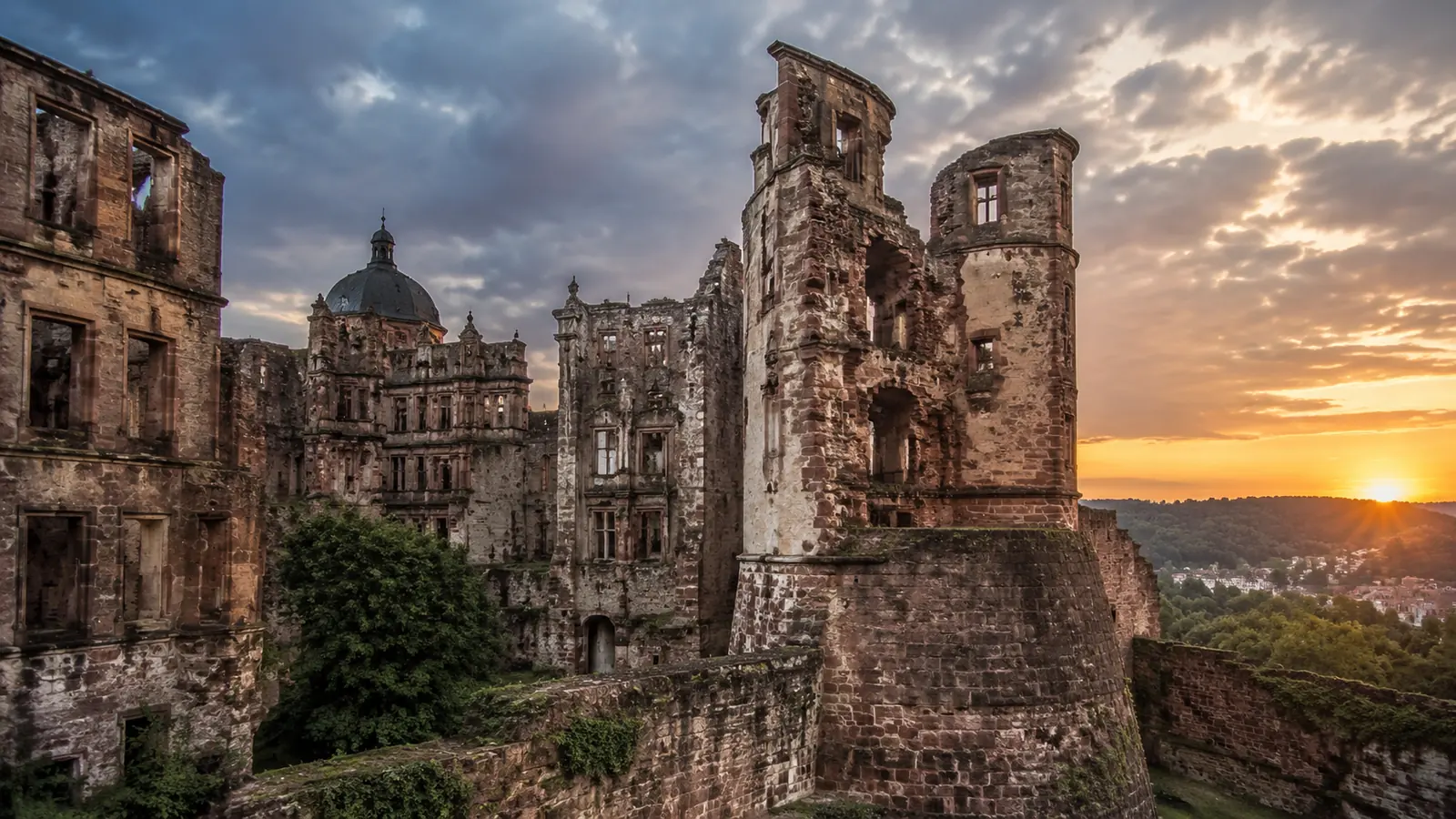
From the 1400s the Prince-Electors of the Palatinate built their residence outward along the Königstuhl hillside, and for a century and a half it kept getting more ambitious. The Ottheinrichsbau of 1556–1559 gave it one of Germany’s finest Renaissance facades. The Friedrichsbau followed in 1601–1607 — its state rooms are the interiors you can visit on a guided tour today. The Elisabethentor gate went up in 1615 for Elizabeth Stuart, the Winter Queen, and below the walls the Hortus Palatinus garden of the early 1600s was talked about as an eighth wonder of the world before war stopped its completion.
1689, 1693: the French wars
The War of the Palatine Succession is the hinge of the whole story. French troops wrecked the castle in 1689 and returned to finish the job in 1693. What war began, weather ended: rebuilding limped on until a lightning strike in 1764, after which the Electors gave up on the hill for good. Then came the quietest destruction of the three — locals quarrying the ruins for building stone, year after year, until Count Charles de Graimberg took up the fight to preserve what remained from 1810.
The romantics arrive
What the French left, the nineteenth century fell in love with. Goethe visited eight times. Turner painted the ruin. Mark Twain stayed in 1878 and gave the castle a chapter of A Tramp Abroad. The ruin was never restored — and that is precisely why it reads as romantic rather than merely old. A rebuilt Heidelberg would be another palace; the wreck is singular, which is the case I make on the worth-it page.
The Great Tun in the cellar postdates the destruction: the Großes Fass of 1751 holds about 220,000 litres, and its legend is Perkeo, the court dwarf who supposedly guarded it and drank prodigiously. The castle was still in use as the wars’ damage accumulated around it.
Why Heidelberg was not bombed in WWII
Visitors regularly assume the damage dates from 1944 or 1945. It does not, and the reason is almost accidental: Heidelberg had no heavy industry and was not a strategic bombing target, so the town below the ruin came through the Second World War essentially undamaged. That is why an intact baroque old town — with Germany’s oldest university, founded 1386 — sits directly beneath a seventeenth-century wreck, and why the US Army later headquartered here for decades. The pairing of ruined castle and unruined town is the single most unusual thing about the place.
Standing in front of it
All of this is legible on site if someone points: which walls the French mined, why the facades do not match, where the lightning finished the argument. The 2-hour guided walk is built exactly around that reading — see the castle tour review — and the complete guide puts the history alongside the practical visit.
Frequently asked questions
What destroyed Heidelberg Castle?
French troops, in 1689 and again in 1693, during the War of the Palatine Succession — then a lightning strike in 1764 ended rebuilding for good, and locals quarried the ruins for stone until Charles de Graimberg began preserving them from 1810. What remains to visit is on the interiors page.
Why was Heidelberg not bombed in WWII?
The town had no heavy industry and was not a strategic bombing target, so it came through the war essentially undamaged — and the US Army later made it a headquarters for decades. The castle’s ruin long predates the war: 1689, 1693 and the lightning of 1764.
Why is Heidelberg Castle so famous?
Partly the architecture — the Ottheinrichsbau is one of Germany’s finest Renaissance facades — and mostly the ruin’s grip on the romantics: Goethe visited eight times, Turner painted it, and Mark Twain put it in A Tramp Abroad after staying in 1878. Where that leaves it against Neuschwanstein is on the most famous castle page.
Was Heidelberg Castle ever rebuilt?
No. Rebuilding was attempted after the French destruction but the 1764 lightning strike ended it, and the castle has been conserved as a ruin ever since. That decision is why the visit feels the way it does — weighed honestly on the worth-it page.